
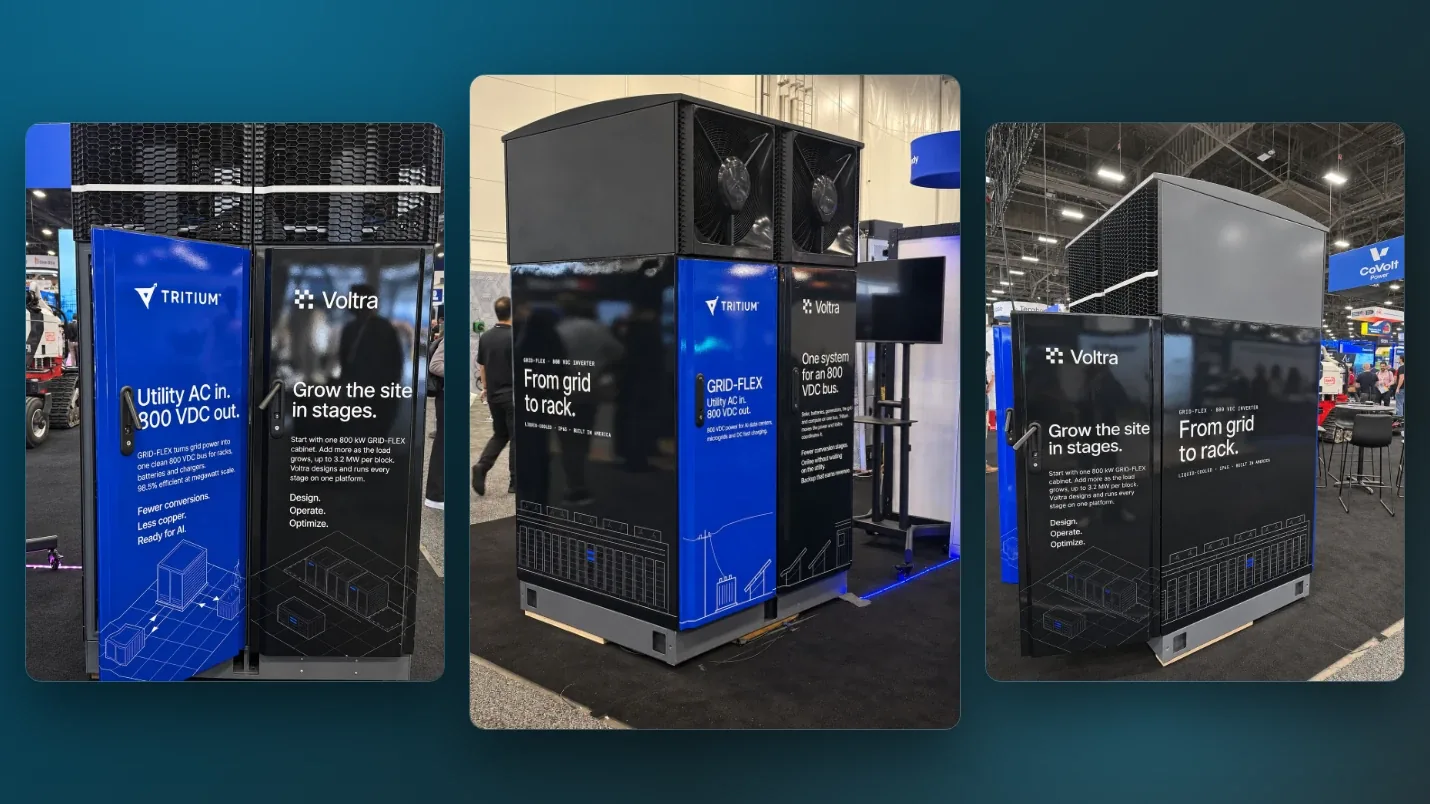
That's a wrap on RE+ 2026. This year we skipped the renderings and brought the real thing to Las Vegas: full-size, production GRID-FLEX hardware, built in our Tennessee plant and shown as the power layer of a microgrid demonstration at the Voltra booth.
Over three days, our team walked developers, EPCs, and technology partners through the equipment, answered technical questions, and talked through real projects. One theme came up in almost every conversation: the wait for power.
Production Hardware on the Show Floor
GRID-FLEX is our 800 VDC bi-directional power conversion platform for data centers, energy storage, and microgrids. At RE+, visitors could stand in front of a 1.6 MW production system made up of 800 kW power conversion cabinets, see its footprint, and talk through how cabinets combine into multi-megawatt installations.
The numbers behind the hardware:
- 800 kW per cabinet, scaling in 800 kW steps up to 3.2 MW per block
- 16 liquid-cooled silicon-carbide modules per cabinet with N+2 redundancy
- 98.5% peak efficiency
- Bi-directional, four-quadrant operation
- IP65 sealed for outdoor sites
- Built in Tennessee, backed by 25 years of Tritium power electronics experience
“There's a difference between talking about power electronics and standing in front of the hardware.”
Three Things We Heard at RE+
1. Seeing the Hardware Changes the Conversation
It is one thing to discuss modular 800 VDC power conversion on paper. It is another to see the equipment, understand its footprint, and work out how multiple cabinets scale into a multi-megawatt site. Conversations at the booth moved quickly from “what is it?” to “how would this fit my project?”
2. Speed to Power Is Driving Decisions
Whether the project is a data center, a microgrid, or a distributed energy site, developers want equipment they can deploy today. Timelines are tightening and power requirements keep growing, which puts proven, scalable power electronics at the top of the list.
3. Energy Infrastructure Is Becoming More Integrated
Battery storage, solar, on-site generation, and large electrical loads are coming together in more projects. That creates demand for flexible power conversion that can support different energy architectures from one platform.
Why the Voltra Pairing Matters
Power hardware is only half of what a developer needs. A site also needs software that can plan it, run it, and monetize it. That is why GRID-FLEX appeared at RE+ inside Voltra's microgrid demonstration: our hardware connects solar, batteries, generators and the grid through one 800 VDC platform, and Voltra's software manages the site around it.
Voltra's new Studio tool takes this a step further. Developers can size a site and lay out GRID-FLEX blocks before they buy.
“The hardest part of a new data center or storage project isn't the building anymore. It's the utility saying ‘years.’”
Pairing production hardware with software that plans and runs the site is how developers shorten that timeline. For a project that is waiting on power, it means megawatts without the wait.
Thank You, and What Comes Next
A big thank you to the Voltra team for hosting us and putting our hardware front and center, and to everyone who stopped by booth C7082 to see GRID-FLEX in person. We came away with excellent conversations and new opportunities to explore.
We are following up on project conversations from the show now. If we spoke at the booth, expect to hear from us soon.
If you missed us, or you are sizing a site that is waiting on power, book a call with Griffin Hewitt, Director of Sales, North America, or explore GRID-FLEX to see the full specifications.